
In this interview, Dr. Nayla Zreik examines the current challenges facing Lebanon’s education system and explains how Lebanese Alternative Learning (LAL) is addressing these obstacles through innovative solutions. She highlights the issues her initiatives aim to resolve and the tangible impact they seek to have on student learning.
| Name | Dr. Nayla Zreik |  |
| Position | Co-founder | |
| Institution | LAL : Lebanese Alternative Learning |
1. What Are LAL’s Key Projects and Initiatives in Lebanon’s Education Sector, and What Concrete Needs Are You Aiming to Address?
LAL’s work begins with a clear diagnosis of Lebanon’s educational landscape. Today, the system faces widening learning gaps resulting from years of successive crises. War, teacher strikes, economic instability, and reduced school days in public institutions have left many students with accumulated academic deficits. Over time, this has led to a gradual loss of essential concepts, knowledge, and skills.
To respond to these needs, LAL focuses on strengthening students’ foundational competencies while addressing learning gaps through personalized instruction delivered via the Tabshoura platform. At the same time, teachers are supported through the Lalmoudaress initiative.
LAL continuously develops educational content on Tabshoura, which currently covers all essential concepts from kindergarten through Grade 9. The organization is now expanding these resources to the secondary level in close collaboration with CERD, ensuring alignment with the new national curricula. Designed as a four-year pilot, the project remains intentionally adaptable to meet evolving on-the-ground realities.
LAL also integrates contemporary challenges into its programs, notably by introducing artificial intelligence while placing strong emphasis on the ethical considerations surrounding its use.
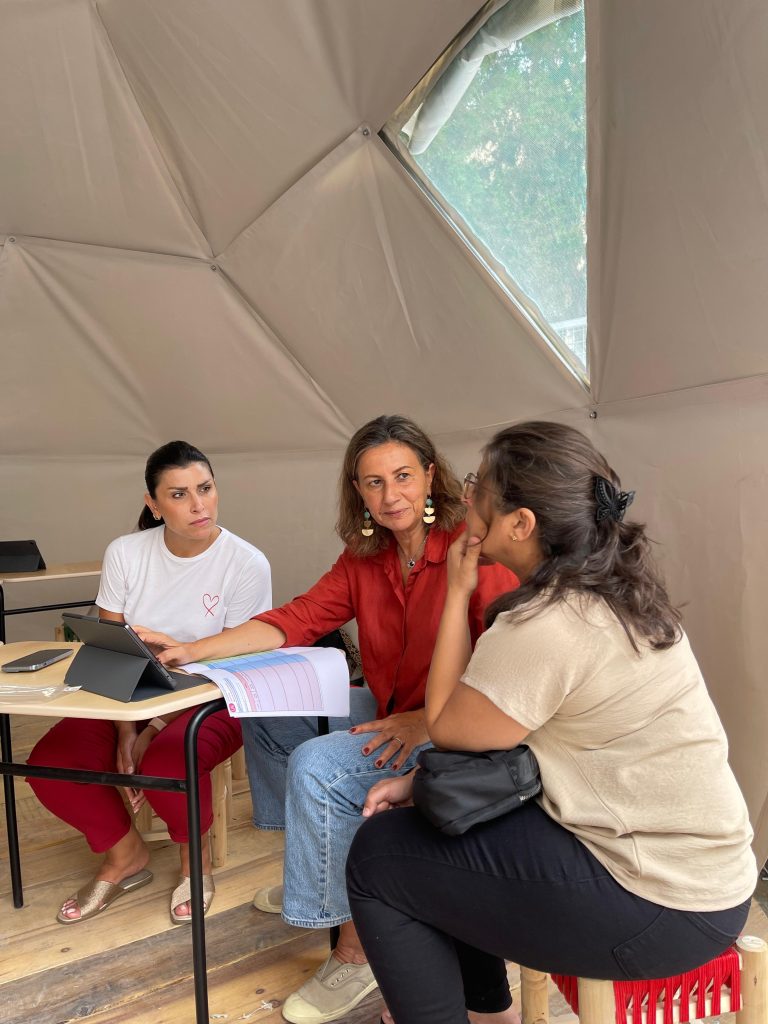
Another major initiative emerged during the war and has continued since: the creation of Alternative Learning Spaces. Today, eleven such spaces operate across public schools, private institutions, and NGOs. Equipped with tailored technological solutions—including offline systems, tablets, computers, and appropriate furnishings—these environments are designed to foster engaging learning experiences, whether integrated into existing classrooms or built as standalone structures.
Finally, in partnership with Kamkalima, an Arabic-language educational platform, and AlNayzak, a Palestinian NGO, LAL is contributing to the development of a digital platform for Palestine titled “Yalla Nudrus.” Beyond content adaptation, the initiative supports local teams in building their capacity to develop digital educational materials, ensuring long-term sustainability and ownership.
2. Who Are You, and What Is LAL’s Mission Within Lebanon’s Educational Landscape?
LAL is an EdTech organization born at the intersection of education and technology. Its work is grounded in three core pillars:
Innovation: Reflected both in pedagogical approaches and in the tools developed. LAL relies on two complementary platforms: Tabshoura for students and Lalmoudaress for teachers, the latter providing pedagogical guidance and a rich library of educational resources. Innovation also extends to improving access to education in vulnerable regions through offline, low-tech solutions adapted to limited connectivity environments.
Expansion: Achieved through growing user adoption, partnerships with schools, the creation of learning spaces, and the organization of training sessions, webinars, and events. To date, LAL has reached 68,000 cumulative users.
Sustainability: Viewed from both financial and impact perspectives. LAL continuously monitors, evaluates, and enhances its platforms and projects. Partnerships with CERD and the Ministry of Education anchor the organization within a national framework and enable it to actively contribute to the evolution of Lebanon’s education system.
3. What Innovative Approach Does LAL Adopt, and How Has It Evolved Over Time?
LAL’s innovation is rooted in a strong pedagogical foundation. While technology plays a central role, it is always deployed in service of education. Behind every tool and piece of content lies thoughtful educational design led by educators working alongside technical teams capable of translating these needs into practical solutions.
A defining element of this approach is genuine partnership with teachers. Rather than being formally consulted, teachers act as true collaborators in designing and producing content. This co-creation—strengthened in recent years—has anchored LAL’s initiatives in real classroom contexts and enhanced their relevance.
4. Based On Your Field Experience, What Barriers Arise When Innovation Is Absent From Education?
One of the most significant barriers is the digital divide. While high-quality educational models can exist without digital tools, they typically emerge in more privileged settings. In vulnerable regions, where access to quality education is already limited, digital technology becomes an essential bridge toward richer and more innovative learning experiences.
Without access to these tools, communities become even more vulnerable, deepening existing inequalities. In this context, innovation is not merely about introducing technology, it is about using it strategically to improve access, quality, and equity in education.
5. In What Ways Do Your Initiatives Better Equip Young People to Face the Challenges of Tomorrow, Especially Within the Lebanese Educational Landscape?
LAL’s initiatives aim primarily to cultivate students’ ability to learn independently and think critically. Rather than relying on passive formats such as lectures or videos, the proposed content centers on interactive activities that place students at the heart of the learning process.
Students are guided through the stages of scientific reasoning: observing, identifying relevant elements, making connections, comparing, contrasting, and drawing conclusions. This methodology strengthens critical thinking, autonomy, and analytical skills which are competencies essential for navigating the challenges of tomorrow, particularly within Lebanon’s context.
6. For LAL, and for You Personally, What Defines the School of the Future?
For LAL, the School of the Future must be diverse and differentiated. In a world shaped by globalization and the standardization of knowledge, tomorrow’s school must preserve local realities, cultures, and varied learning approaches.
The School of the Future is not a single model, but an adaptive space capable of responding to learners’ needs, respecting their individuality, and offering differentiated educational pathways deeply rooted in their context yet open to the world.